

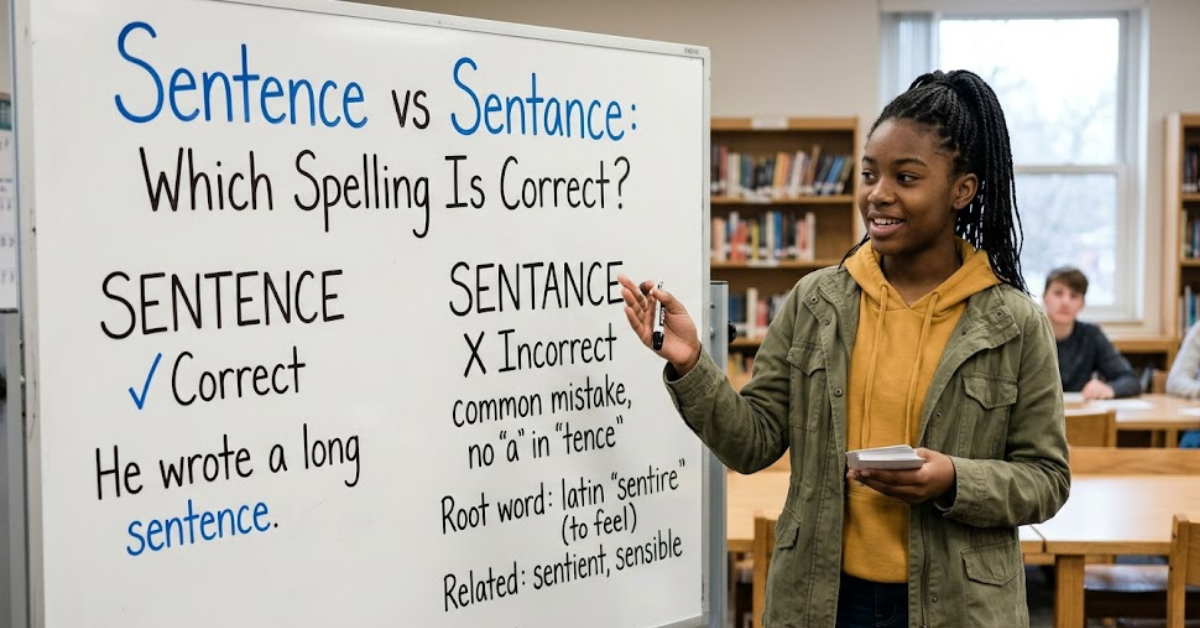
Have you ever typed sentance and wondered if it was actually correct? You’re not alone. Many English learners and native speakers alike confuse sentence vs sentance because the words sound almost identical when spoken aloud.
The good news is simple: sentence is the correct spelling, while sentance is a common misspelling. In this guide, you’ll learn why the confusion happens, how the word is used in British and American English, and easy tricks to remember the right spelling every time.
Whether you’re writing an essay, email, or social media caption, understanding the difference can instantly improve your writing accuracy.
What Does “Sentence” Mean?
A sentence is a group of words that expresses a complete thought. In grammar, it usually contains:
- A subject
- A verb
- A complete idea
For example:
- She loves reading books.
- The weather is beautiful today.
- We are going to the market.
In legal contexts, the word can also refer to a punishment ordered by a court.
Example:
- The judge gave him a five-year sentence.
The meaning depends on the context, but the spelling always stays the same.
Is “Sentance” a Real Word?
No, sentance is not considered a correct English word. It is simply a spelling mistake of sentence.
People often write sentance because English pronunciation can be misleading. The second syllable in sentence sounds similar to “tence,” which causes confusion.
However, dictionaries, grammar guides, and style manuals all recognize only one correct spelling:
- Correct: sentence
- Incorrect: sentance
Sentence vs Sentance UK Usage
One of the most common questions online is whether British English uses sentance instead of sentence. The answer is no.
In both the UK and the US, sentence is the accepted spelling. British English does not change this word.
So if you’re searching for sentence vs sentance uk, remember this rule:
- British English: sentence
- American English: sentence
The spelling remains identical across major English dialects.
Why People Misspell “Sentence”
English spelling is full of patterns that don’t always match pronunciation. That’s one reason this mistake appears so often.
Here are the main causes of the confusion:
1. Pronunciation Similarity
When spoken quickly, sentence can sound like “sentance,” especially in casual conversation.
2. Other Words Ending in “-ance”
English includes many words ending in “-ance,” such as:
- performance
- attendance
- importance
Because of these patterns, some writers assume sentance follows the same rule.
3. Typing Habits
Autocorrect doesn’t always catch every typo immediately, particularly if someone repeatedly uses the incorrect spelling.
Easy Trick to Remember the Correct Spelling
A simple memory trick can help:
The word sentence contains “ten,” just like the word “tense,” which is related to grammar.
Think:
- sentence → grammar → tense
This association makes it easier to remember that the correct ending is -ence, not -ance.
Examples of Correct Usage
Here are some examples showing how to use sentence properly in writing.
Grammar Examples
- This sentence is too long.
- Please write a complete sentence.
- Her opening sentence grabbed everyone’s attention.
Legal Examples
- He received a short prison sentence.
- The court reduced her sentence last week.
- The judge announced the final sentence today.
Common Spelling Mistakes Similar to “Sentance”
The English language contains many commonly confused spellings. If you’ve written sentance before, you might also struggle with words like:
- difference vs differance
- existence vs existance
- occurrence vs occurance
- absence vs absance
Most of these errors happen because English pronunciation does not always reflect spelling rules clearly.
How Spell Checkers Handle the Word
Most modern spell-check tools automatically flag sentance as incorrect. Programs like:
- Google Docs
- Microsoft Word
- Grammarly
usually suggest sentence immediately.
Still, relying only on spell check isn’t ideal. Building strong spelling habits helps improve both academic and professional writing.
Is “Sentence” Used Differently in British and American English?
The spelling stays the same, but there can be small differences in punctuation style and sentence structure between UK and US English.
For example:
British English
- She realised the sentence was unclear.
American English
- She realized the sentence was unclear.
Notice that the difference is in realised/realized, not in the word sentence itself.
How to Avoid This Mistake in Writing
If you want to avoid spelling errors like this, try these practical tips:
Read More Often
Frequent reading helps your brain recognize correct spelling naturally.
Proofread Slowly
Reading your writing word by word makes spelling mistakes easier to catch.
Learn Word Patterns
Words ending in “-ence” often follow recognizable spelling structures.
Examples include:
- silence
- presence
- confidence
- sentence
Use Writing Tools Carefully
Grammar tools are helpful, but understanding the rules yourself is even more valuable.
Why Correct Spelling Matters
Some people assume minor spelling mistakes are unimportant, but errors can affect how your writing is perceived.
Correct spelling helps you:
- Look more professional
- Improve readability
- Build credibility
- Communicate clearly
Even a small typo like sentance can distract readers from your message.
FAQs
Is sentance ever correct?
No. Sentance is always considered a misspelling of sentence.
What is the correct spelling in the UK?
The correct British spelling is sentence. There is no UK variation using sentance.
Why do people write sentance instead of sentence?
The mistake usually happens because the pronunciation sounds similar to words ending in “-ance.”
How do you use sentence in a sentence?
Example: “Please write one clear sentence about your experience.”
Is sentence a grammar term?
Yes. In grammar, a sentence is a complete unit of meaning containing a subject and verb.
Conclusion
Understanding sentence vs sentance is easier than it first appears. The only correct spelling is sentence, whether you’re writing in American or British English. The word sentance is simply a common typo caused by pronunciation and spelling confusion.
If you often mix them up, focus on remembering the “-ence” ending and practice using the word in everyday writing. Small grammar improvements like this can make your communication clearer, stronger, and more professional.
For more grammar guides and spelling comparisons, explore related language articles and keep sharpening your writing skills.