

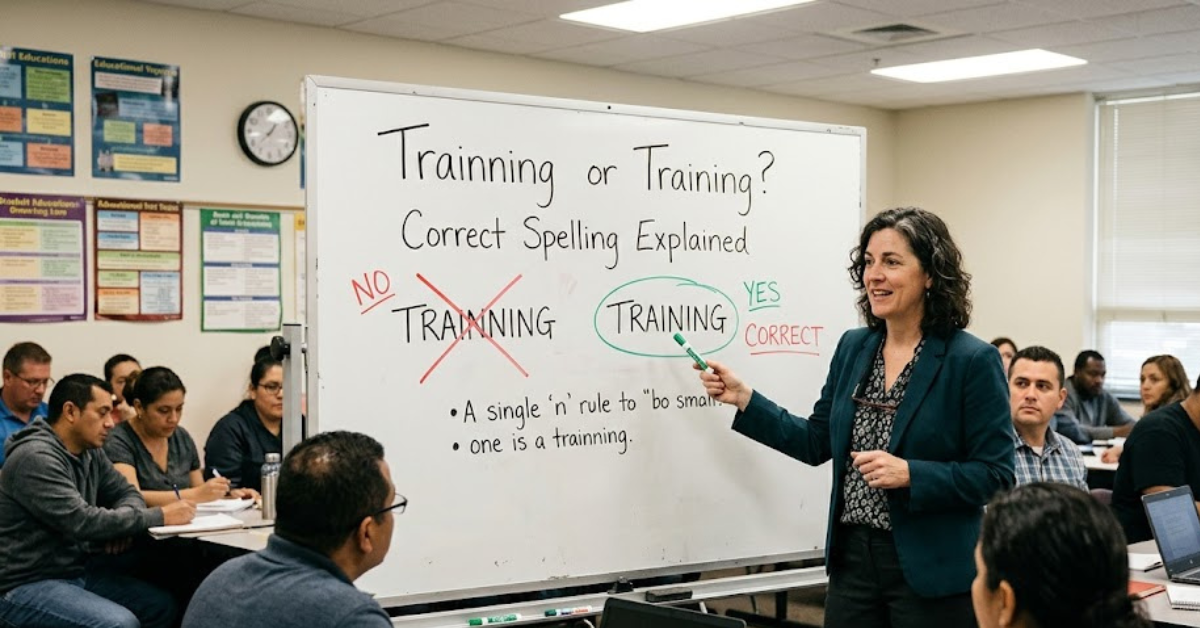
Many English learners and even native speakers get confused between “trainning” and “training.” At first glance, both words may look acceptable, but only one is grammatically correct in standard English. If you have ever searched for “Trainning or Training” or wondered which spelling should be used in writing, emails, resumes, or academic work, this guide will clear up the confusion.
The short answer is simple: “training” is the correct spelling, while “trainning” is considered a spelling mistake. However, understanding why it is incorrect can help you avoid similar grammar errors in the future.
In this article, you will learn the correct meaning, spelling rules, Oxford dictionary explanation, examples, common mistakes, and practical usage tips.
What Does Training Mean?
The word “training” refers to the process of learning skills, improving abilities, or preparing someone for a specific task, profession, sport, or activity.
It comes from the verb “train,” which means to teach, instruct, or prepare.
Common Definitions of Training
Training can mean:
- Teaching someone a skill
- Practicing to improve performance
- Preparing for work or sports
- Learning through instruction and experience
Examples in Sentences
- She completed her employee training last week.
- The football team started training early in the morning.
- Proper safety training is required before using the machine.
- He joined a training program to improve his communication skills.
In all of these examples, “training” is the correct form.
Trainning or Training: Which One Is Correct?
The correct spelling is:
- Training
- Trainning
The word “trainning” is not recognized as a standard English word in dictionaries or grammar references.
Why Is “Trainning” Incorrect?
Many spelling mistakes happen because English words sometimes double consonants before adding endings like “-ing.” People assume the word “train” should become “trainning,” but English spelling rules do not work that way here.
The base word is:
- Train
When adding “-ing,” it becomes:
- Training
The “n” is not doubled because the word does not follow the consonant-doubling pattern used in words like:
- Run → Running
- Swim → Swimming
- Sit → Sitting
In those examples, the vowel sound is short and the final consonant is doubled before adding “-ing.”
But “train” already contains a vowel combination (“ai”), so the spelling remains unchanged.
Trainning or Training Meaning
When people search for “trainning or training meaning,” they usually want to know whether both words have different meanings. The answer is no.
Only “training” has an actual meaning in English. “Trainning” has no official meaning because it is simply a misspelling.
Meaning of Training
Training means:
- Instruction
- Practice
- Skill development
- Preparation for a role or activity
It can be used in many contexts, including:
Workplace Training
Companies provide training to employees so they can improve job performance.
Sports Training
Athletes follow strict training schedules to build strength and endurance.
Educational Training
Students and professionals attend training sessions to learn new skills.
Technical Training
Specialized industries often require technical training before work begins.
Trainning or Training Oxford Dictionary Explanation
According to the Oxford English Dictionary, “training” is a recognized noun referring to teaching, practice, or preparation that develops skills or behavior.
The Oxford definition generally describes training as:
The process of learning the skills needed for a particular job or activity.
The spelling “trainning” does not appear as a valid English word in the dictionary.
This confirms that “training” is the only acceptable spelling in formal and informal English.
Common Reasons People Write “Trainning”
Spelling mistakes like this are extremely common, especially among English learners. Here are a few reasons why people accidentally write “trainning”:
Confusion With Double-Consonant Rules
Words like “running” and “swimming” make learners think every word ending in “-ing” needs an extra consonant.
Fast Typing
Typing quickly often causes accidental letter duplication.
Pronunciation Assumptions
Some people spell words based on how they sound rather than official spelling rules.
Autocorrect Errors
Occasionally, typing software may fail to correct the mistake immediately.
How to Remember the Correct Spelling
A simple trick can help you remember the right version.
Think of the Base Word
The root word is “train.”
Just add “-ing”:
- Train + ing = Training
No extra “n” is needed.
Memory Tip
If the original word already has two vowels together like “ai,” you usually do not double the consonant before adding “-ing.”
Examples of Correct Usage
Here are some everyday examples showing the proper spelling.
Professional Examples
- Employee training improves workplace productivity.
- The company offers online training courses.
Academic Examples
- Teacher training programs are becoming more advanced.
- She attended medical training seminars.
Fitness and Sports Examples
- Marathon training requires consistency.
- His training routine includes weightlifting and cardio.
Technology Examples
- AI training data helps improve machine learning systems.
- Cybersecurity training is important for employees.
Incorrect vs Correct Examples
Incorrect
- I completed my trainning yesterday.
- The coach planned intense trainning sessions.
Correct
- I completed my training yesterday.
- The coach planned intense training sessions.
Using the correct spelling makes your writing look more professional and credible.
Is “Training” a Noun or Verb?
“Training” is most commonly used as a noun, but it can also function as part of a verb phrase.
As a Noun
- The training starts tomorrow.
As a Verb Form
- She is training for a competition.
In the second example, “training” acts as the present participle of the verb “train.”
Similar Spelling Mistakes in English
The confusion between “trainning” and “training” is similar to many other common spelling errors.
Examples
- Begining → Beginning
- Planing → Planning
- Writeing → Writing
- Developement → Development
English spelling patterns can be tricky, which is why proofreading is important.
Why Correct Spelling Matters
Correct spelling is more important than many people realize. Whether you are writing an email, resume, article, or social media post, spelling affects credibility.
Benefits of Correct Spelling
- Makes writing look professional
- Improves communication clarity
- Builds trust with readers
- Helps in academic and workplace settings
Even small spelling mistakes can create confusion or reduce confidence in your writing.
Frequently Asked Questions
Is trainning a real word?
No, “trainning” is not a correct English word. The proper spelling is “training.”
What is the correct spelling: trainning or training?
“Training” is the correct spelling used in standard English grammar and dictionaries.
Why do people write trainning?
People often confuse English consonant-doubling rules and mistakenly add an extra “n.”
What does training mean?
Training means learning skills, practicing, or preparing for a specific task, job, or activity.
Is training a noun?
Yes, “training” is commonly used as a noun, though it can also appear as a verb form.
Does the Oxford dictionary include trainning?
No. The Oxford dictionary recognizes only “training” as the correct spelling.
How can I remember the correct spelling?
Remember the base word “train.” Simply add “-ing” without doubling the “n.”
Conclusion
The debate around “Trainning or Training” is actually very simple once you understand English spelling rules. “Training” is the correct and officially recognized spelling, while “trainning” is a common typo or spelling mistake.
Understanding why the spelling works this way can help improve your English writing skills and prevent similar errors in the future. Whether you are writing professionally, academically, or casually, using the correct form makes your communication clearer and more polished.
If you frequently confuse English spellings, practicing word patterns and reading regularly can make a big difference over time.