

Have you ever paused while writing and wondered whether to use farther or further? You’re not alone. These two words are among the most commonly confused terms in English because they look similar, sound similar, and are often used interchangeably.
The debate around farther vs further has existed for decades, and even experienced writers occasionally hesitate before choosing one. While modern usage has become more flexible, understanding the traditional distinction can help you write more clearly and confidently.
In this guide, you’ll learn the meaning of each word, the key grammar rules, practical examples, pronunciation tips, and simple ways to remember which one to use.
What Is the Difference Between Farther and Further?
The traditional distinction is simple:
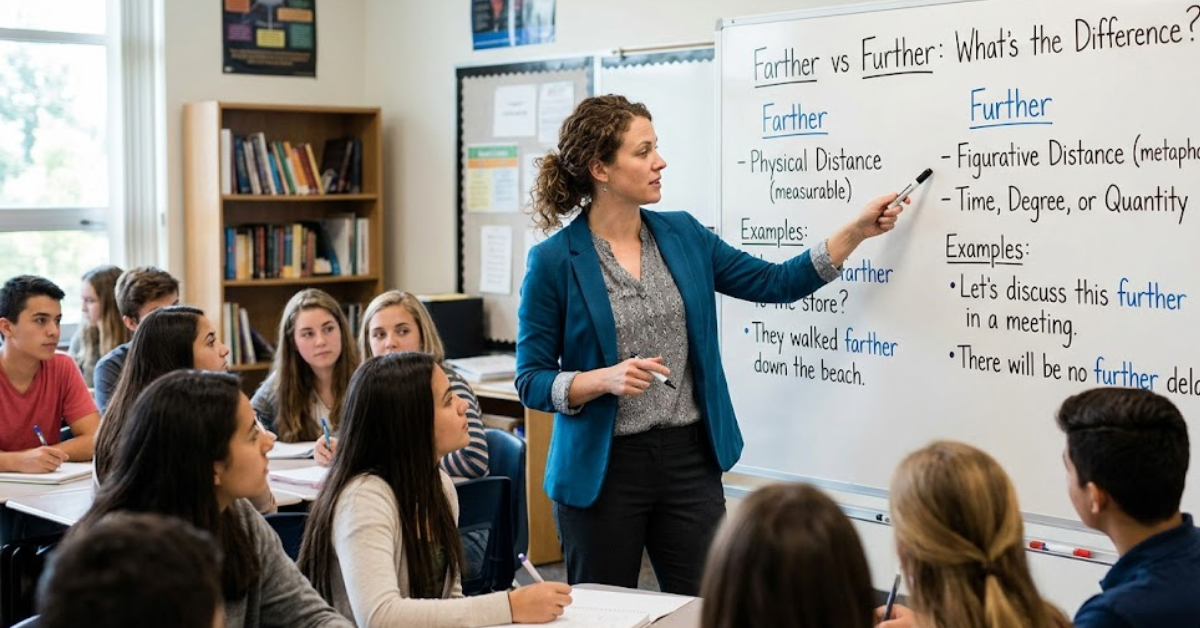
- Farther refers to a physical distance.
- Further refers to a figurative distance, degree, extent, or advancement.
Think of it this way:
- If you can measure the distance in miles, feet, or kilometers, use farther.
- If you’re talking about progress, ideas, time, discussion, or development, use further.
Quick Examples
Farther
- The gas station is farther down the road.
- She threw the ball farther than anyone else.
- We walked farther than expected.
Further
- We need further investigation before making a decision.
- The meeting was postponed until further notice.
- She wanted to further her education.
Although these distinctions are widely taught, modern English speakers sometimes use further in both contexts.
Farther vs Further Meaning
Understanding the meanings of both words makes choosing the correct one much easier.
Meaning of Farther
Farther is the comparative form of far. It specifically refers to measurable physical distance.
Examples:
- The mountain is farther away than it appears.
- Their house is farther from town than ours.
- We drove farther than planned.
Meaning of Further
Further can describe additional distance, but it more commonly refers to advancement, degree, time, quantity, or abstract concepts.
Examples:
- We need further information.
- The project requires further discussion.
- She hopes to further her career.
Farther vs Further Usage in Modern English
In everyday conversation, many native speakers use further for almost everything. This trend has become increasingly common in journalism, business writing, and casual communication.
However, many grammar guides still recommend maintaining the traditional distinction because it adds clarity.
Traditional Rule
Use farther for:
- Physical distance
- Measurable locations
- Geographic movement
Use further for:
- Time
- Ideas
- Discussions
- Progress
- Education
- Research
- Additional amounts
When to Use Farther vs Further
A simple question can help:
Can you physically measure the distance?
If yes, choose farther.
Examples:
- The park is farther from my house.
- The runner moved farther ahead.
If no, choose further.
Examples:
- We need further clarification.
- The investigation continued further.
Farther vs Further for Time
Time can be tricky because it isn’t a physical distance.
In most cases, further is preferred when discussing time.
Examples:
- The issue was delayed for a further week.
- Further delays could affect the project.
- We will discuss this further tomorrow.
Because time is considered abstract rather than physical, grammar experts generally favor further in these situations.
Farther vs Further Examples
Looking at real-world examples can make the distinction easier to remember.
Physical Distance Examples
- My office is farther from the station than yours.
- The hikers traveled farther into the forest.
- The next town is farther north.
Abstract Distance Examples
- We should examine the issue further.
- Further research is needed.
- He wants to further his professional skills.
Mixed Examples
Correct:
- We drove farther than expected.
- We discussed the matter further afterward.
Incorrect:
- We drove further than expected. (Often accepted today but traditionally less precise.)
- We discussed the matter farther afterward.
Farther vs Further Grammar Rules
Here are the most important rules to remember:
Rule 1: Use Farther for Physical Distance
Correct:
- The lake is farther away.
Rule 2: Use Further for Abstract Concepts
Correct:
- Further explanation is necessary.
Rule 3: Use Further as a Verb
Only further can function as a verb.
Examples:
- She hopes to further her career.
- The scholarship helped further his education.
Rule 4: Further Often Means “Additional”
Examples:
- Further questions?
- Further details will be provided later.
Farther vs Further Pronunciation
The pronunciation difference is small.
Farther
Pronounced:
FAHR-ther
Further
Pronounced:
FUR-ther
The first syllable changes slightly, but both words remain easy to distinguish in spoken English.
Farther vs Further in UK and American English
Both British and American English recognize the traditional distinction.
However, usage patterns vary.
American English
American style guides often encourage:
- Farther for physical distance
- Further for figurative distance
British English
British writers are generally more comfortable using further in a wider range of situations, including some references to physical distance.
As a result, you’ll often encounter further where Americans might prefer farther.
What Do Major Dictionaries Say?
Many modern dictionaries acknowledge that the distinction has become less strict over time.
According to common dictionary guidance, farther remains the preferred choice for measurable distance, while further is typically favored for abstract meanings and additional amounts.
This reflects how language naturally evolves while preserving useful distinctions.
Easy Memory Trick
If you’re struggling to remember which word to use, try this:
Farther contains the word “far.”
Since far relates to physical distance, farther is usually the better choice when measuring space.
For everything else—ideas, progress, discussions, time, and additional information—choose further.
Common Mistakes to Avoid
Mistake 1: Using Farther for Ideas
Incorrect:
- We need farther analysis.
Correct:
- We need further analysis.
Mistake 2: Forgetting That Further Can Be a Verb
Correct:
- The training will further your skills.
Mistake 3: Assuming They Are Always Interchangeable
Although many people use them interchangeably, choosing the more precise option makes your writing stronger.
Practice Quiz
Choose the correct word.
- The store is ______ down the street.
- We need ______ information.
- She walked ______ than anyone else.
- The company wants to ______ innovation.
- The discussion continued ______.
Answers
- farther
- further
- farther
- further
- further
Frequently Asked Questions
Is there really a difference between farther and further?
Yes. Traditionally, farther refers to physical distance, while further refers to abstract distance, advancement, or additional information.
Can further be used for physical distance?
Yes. Modern English often accepts further for physical distance, although many style guides still prefer farther for greater precision.
Which is more common, farther or further?
Further is generally more common because it works in both literal and figurative contexts.
Is farther wrong?
No. It remains the preferred word when discussing measurable physical distance.
Can farther be used as a verb?
No. Only further can function as a verb, meaning to advance or promote something.
Which word should I use in formal writing?
For the clearest and most polished writing:
- Use farther for physical distance.
- Use further for abstract ideas, progress, time, and additional information.
Conclusion
Understanding farther vs further doesn’t have to be complicated. The easiest rule is to use farther when discussing measurable physical distance and further when talking about ideas, time, progress, or anything abstract.
While modern English often treats the two words as interchangeable, following the traditional distinction can improve clarity and strengthen your writing. The next time you’re unsure which word to choose, simply ask yourself whether you’re talking about a real distance you can measure or a figurative concept you can’t.
Mastering this small grammar distinction will help make your communication more accurate, professional, and confident.