

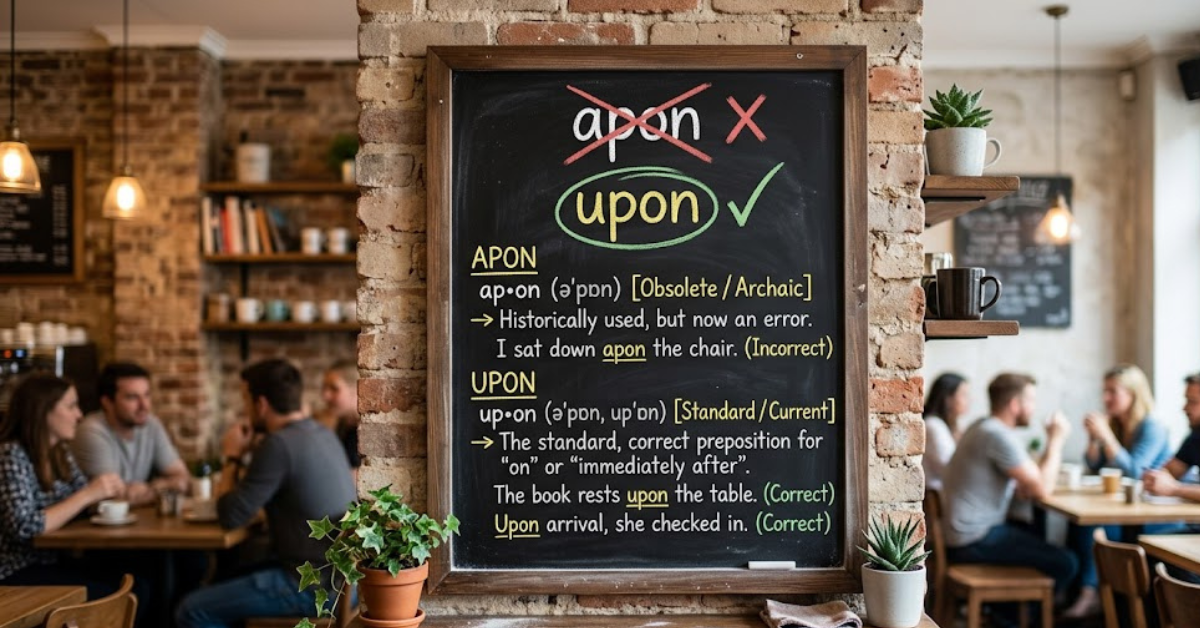
If you’ve ever seen the phrase apon vs upon, you might have paused and wondered which one is actually correct. These two look similar, and in spoken English they can even sound alike, which leads to a lot of confusion in writing.
The truth is simple: one of these is standard English, while the other is often a spelling mistake or outdated variation. In this guide, we’ll break down upon vs apon, explain the meaning of “upon,” and show you exactly how to use it correctly in everyday writing.
Apon vs Upon: The Quick Answer
The correct word in modern English is:
Upon
The word “apon” is generally considered:
A misspelling
Non-standard English
Occasionally found in old or informal texts
So when choosing between apon vs upon, always use upon.
What Does “Upon” Mean?
The word upon is a preposition used to show:
- Time or timing
- Position or location
- Condition or consequence
It is slightly more formal than “on,” but both are often interchangeable.
Common Meanings of “Upon”
1. Time (something happening immediately)
- Upon arrival, we will begin the meeting.
- Upon hearing the news, she cried.
2. Position (resting or placed on something)
- The book lay upon the table.
- He placed his hand upon her shoulder.
3. Condition (as a result of something)
- Upon approval, the project will start.
- Payment is made upon completion.
Upon vs Apon: Why the Confusion Happens
The confusion in upon vs apon usually comes from pronunciation and informal writing habits.
Common reasons:
- “Upon” is pronounced quickly in speech
- Some people drop the “u” sound when speaking
- Typing errors and autocorrect mistakes
- Influence of older or informal spellings online
However, in standard English, only upon is correct.
Apon Meaning: Does It Exist?
Many people search for apon meaning, but in modern English dictionaries, “apon” has no official meaning.
Important clarification:
- Apon = not a recognized English word
- Upon = correct preposition with multiple meanings
If you see “apon” online, it is almost always a typo or incorrect spelling of “upon.”
Apon Upon: Side-by-Side Comparison
Here’s a simple breakdown of apon upon:
| Word | Status | Meaning |
| Upon | Correct | Preposition (on, immediately after, based on) |
| Apon | Incorrect | No standard meaning |
How to Use “Upon” in Sentences
Let’s look at real-world usage so it becomes easy to understand.
Time-based usage:
- Upon entering the room, he noticed the silence.
- Upon finishing the task, she left early.
Formal writing:
- The agreement will be finalized upon review.
- Upon request, additional details will be provided.
Everyday usage:
- I will call you upon arrival.
- She smiled upon seeing her friend.
When to Use “Upon” vs “On”
In many cases, “upon” and “on” are interchangeable, but tone matters.
Use “upon” when:
- Writing formally
- Emphasizing immediacy
- Using traditional or literary tone
Use “on” when:
- Writing casually
- Speaking informally
- Keeping language simple
Example:
- Formal: Upon completion, submit the report.
- Casual: On completion, submit the report.
Common Mistakes to Avoid
Mistake #1: Using “apon”
- Upon arrival → Apon arrival
- Correct: Upon arrival
Mistake #2: Overusing “upon” in casual writing
It can make writing sound overly formal.
Mistake #3: Confusing “upon” with “up on”
These are different:
- Upon = preposition
- Up on = phrasal phrase (literal direction)
Easy Trick to Remember
Here’s a simple memory tip:
“Upon = Up + On (correct joined form)”
“Apon = just a typo, ignore it”
Whenever you hesitate, remember that only “upon” exists in standard English.
Frequently Asked Questions
What is the correct spelling: apon or upon?
The correct spelling is upon. “Apon” is incorrect.
What does “apon” mean?
“Apon” does not have a recognized meaning in modern English.
Is “upon” formal or informal?
“Upon” is more formal than “on” and is often used in writing.
Can I use “upon” instead of “on”?
Yes, in many cases, but “upon” sounds more formal or literary.
Why do people write “apon”?
It is usually a typing error or mishearing of the word “upon.”
Conclusion
The confusion between apon vs upon is common, but the answer is straightforward: only upon is correct in standard English. It is a versatile preposition used to describe time, position, and conditions.
While “apon meaning” may appear in searches, it has no real definition in modern English. By remembering this simple rule, you can avoid a common writing mistake and improve the clarity of your communication. The next time you see upon vs apon, you’ll know exactly which one to choose.