

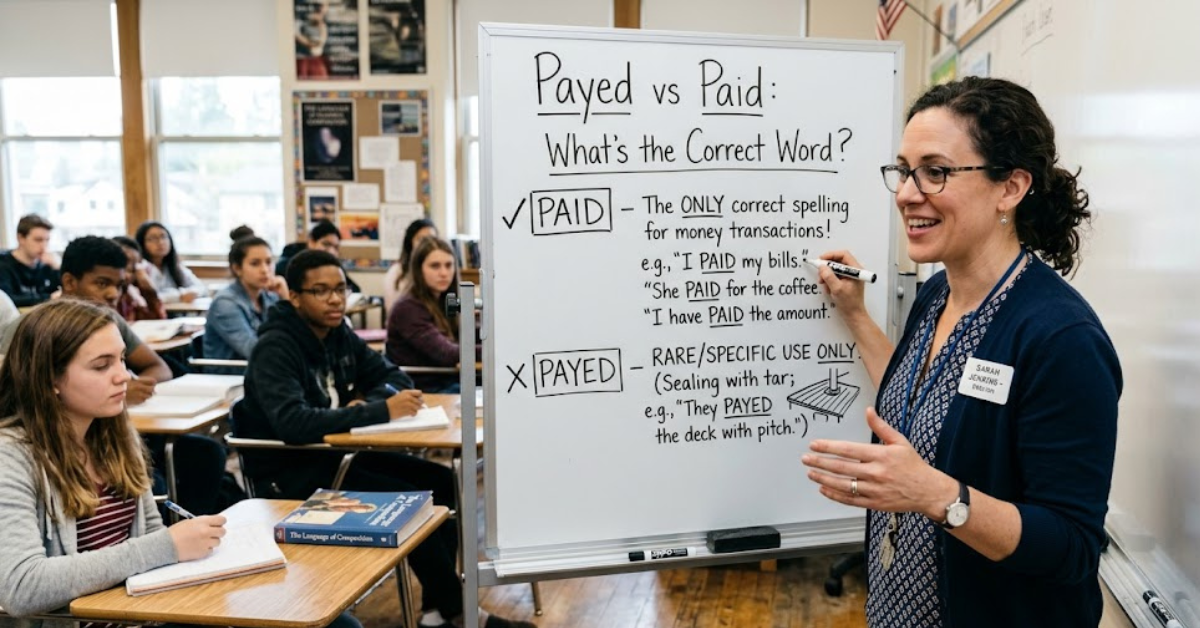
English is full of confusing word pairs, but few create as much uncertainty as payed vs paid. Many people assume “payed” is simply a misspelling of “paid,” while others use both interchangeably without realizing they have different meanings.
If you have ever typed “I payed the bill” and wondered whether it looked correct, you are not alone. The confusion exists because both words technically exist in English, but only one is correct in most everyday situations.
In this guide, you will learn the difference between “payed” and “paid,” how grammar rules apply, when each word should be used, and plenty of real-life examples to make everything clear.
What Is the Difference Between Payed vs Paid?
The main difference is simple:
- Paid is the correct past tense of the verb “pay” in nearly all situations.
- Payed is a rare specialized term mostly used in nautical contexts.
For example:
- Correct: “She paid the rent yesterday.”
- Incorrect: “She payed the rent yesterday.”
In normal writing, business communication, school assignments, and conversations, “paid” is almost always the right choice.
Why Do People Confuse Payed and Paid?
The confusion happens because English verbs often form the past tense by adding “-ed.”
Examples include:
- Walk → Walked
- Jump → Jumped
- Clean → Cleaned
So naturally, many learners assume:
- Pay → Payed
However, “pay” is an irregular verb, meaning it does not follow the standard pattern. Its correct past tense becomes “paid,” not “payed.”
This is similar to:
- Say → Said
- Lay → Laid
English grammar can be unpredictable, which is why this mistake is extremely common.
What Does Paid Mean?
“Paid” is the past tense and past participle of the verb “pay.” It refers to giving money, settling debts, compensating someone, or receiving a reward for effort.
Common Uses of “Paid”
People use “paid” in many everyday situations:
- Paid money
- Paid attention
- Paid off
- Paid bills
- Paid a fine
- Paid respect
Examples of Paid in Sentences
Here are some clear examples:
- I paid the electricity bill this morning.
- She paid attention during the lecture.
- They paid extra for express delivery.
- His hard work finally paid off.
- We already paid for dinner.
These are all grammatically correct uses.
What Does Payed Mean?
“Payed” is a legitimate English word, but it has a very limited meaning.
Traditionally, it is used in nautical and sailing contexts. It refers to:
- Letting out rope or chain slowly
- Coating a ship’s surface with tar or waterproof material
Examples of Payed
- The sailors payed out the rope carefully.
- The deck was payed with tar to prevent leaks.
Unless you are discussing ships, sailing, or maritime work, you probably will never need to use “payed.”
Payed vs Paid Grammar Rules
Understanding the grammar behind these words makes the difference easier to remember.
“Paid” Is an Irregular Verb Form
The verb “pay” changes irregularly:
- Present: Pay
- Past: Paid
- Past participle: Paid
Examples:
- I pay my bills on time.
- Yesterday, I paid my bills.
- I have already paid the invoice.
“Payed” Is Not Standard Grammar
Using “payed” in ordinary writing is considered a spelling mistake.
Incorrect:
- I payed the cashier.
Correct:
- I paid the cashier.
Most grammar checkers and dictionaries flag “payed” as incorrect unless the context relates to sailing.
Payed vs Paid Attention
One of the most searched phrases online is payed vs paid attention because many people accidentally write:
- “He payed attention.”
The correct phrase is:
- “He paid attention.”
“Paid attention” is an idiom that means focusing carefully on something.
Examples:
- She paid attention to the instructions.
- Students who paid attention scored higher marks.
Using “payed attention” is grammatically wrong in standard English.
Payed vs Paid Money
Another common mistake appears when discussing money.
Correct examples include:
- I paid money for the tickets.
- They paid him in cash.
- She paid the fee online.
Incorrect examples include:
- I payed money for the tickets.
- He payed the bill.
Since these situations involve financial payment, “paid” is always correct.
Payed vs Paid Off
The phrase “paid off” has two common meanings:
- A debt was completely settled
- Effort produced good results
Examples:
- We finally paid off the car loan.
- Her patience paid off in the end.
“Payed off” is incorrect in standard usage.
Merriam-Webster Payed vs Paid Explanation
According to major dictionaries, including Merriam-Webster, “paid” is the standard past tense of “pay.”
“Payed” exists only in specialized nautical meanings. This matches the guidance provided by nearly all modern grammar references.
So if you are writing emails, essays, articles, captions, or business documents, “paid” is almost certainly the correct choice.
Payed vs Paid UK Usage
In both American and British English, “paid” remains the standard spelling for the past tense of “pay.”
Examples in UK English:
- He paid the parking fee.
- She paid for the train ticket.
British English does not commonly use “payed” outside maritime terminology either.
I Payed vs Paid: Which Is Correct?
If you are wondering whether to write “I payed” or “I paid,” the answer is easy:
- Correct: I paid
- Incorrect: I payed
Examples:
- I paid my rent yesterday.
- I paid for lunch.
- I paid attention in class.
“I payed” would only work in a very rare nautical sentence.
Easy Trick to Remember the Difference
A simple memory trick can help:
If the sentence involves:
- Money
- Bills
- Attention
- Work
- Rewards
- Costs
Then use paid.
If the sentence involves:
- Ships
- Ropes
- Sailing equipment
- Tar coating
Then “payed” may be correct.
For 99% of people, “paid” is the word you need.
Common Mistakes to Avoid
Here are mistakes many writers make:
Incorrect:
- She payed the waiter.
- We payed attention.
- The investment payed off.
Correct:
- She paid the waiter.
- We paid attention.
- The investment paid off.
Proofreading carefully can help you catch this error before publishing or sending your writing.
Why “Paid” Looks Strange to Some People
Many English learners expect words to follow regular patterns. Since “pay” ends with a vowel sound, “paid” can initially seem unusual.
But English contains many irregular verbs that developed historically over time. That is why some spellings look inconsistent today.
The more you read and write, the more natural “paid” becomes.
Frequently Asked Questions
Is “payed” ever correct?
Yes, but only in nautical contexts involving ropes, chains, or sealing ships with tar.
Which is correct: paid attention or payed attention?
“Paid attention” is correct.
Is “I payed” grammatically wrong?
In ordinary English, yes. The correct phrase is “I paid.”
Why is it paid instead of payed?
Because “pay” is an irregular verb, similar to “say” becoming “said.”
Do British people use “payed”?
Only in rare maritime situations. Everyday UK English uses “paid.”
Is “paid off” correct?
Yes. “Paid off” is the proper phrase when discussing debts or successful results.
Final Thoughts on Payed vs Paid
Understanding payed vs paid becomes much easier once you know one key rule: “paid” is the correct past tense of “pay” in almost every situation.
While “payed” is technically a real word, its use is limited to specialized nautical language that most people never encounter in daily life.
So the next time you write about bills, salaries, attention, loans, or expenses, confidently choose “paid.” It is the grammatically correct form, accepted in both American and British English, and the version readers expect to see.
If you enjoy learning about confusing English words and grammar differences, explore other commonly mixed-up terms to sharpen your writing skills even further.