

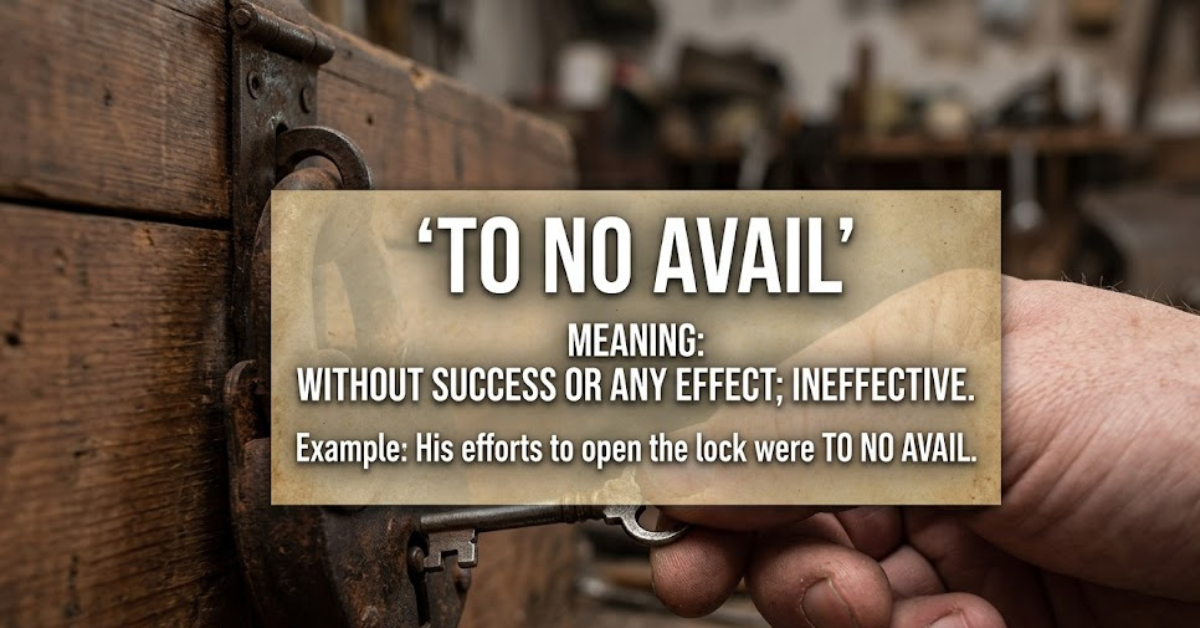
If you’ve ever come across the phrase to no avail meaning and felt slightly confused, you’re not alone. It’s one of those classic English expressions that sounds formal, slightly old-fashioned, and a bit unclear at first glance.
In simple terms, “to no avail” means that something was done without success. In this article, we’ll break down the no avail meaning, explore its usage, and show you real examples so you can confidently use it in writing and conversation.
What Does “To No Avail” Mean?
The phrase to no avail meaning refers to an action that fails to produce any result or success.
Simple definition:
To no avail = without success or without achieving the desired result.
Examples:
- She tried calling him repeatedly, but to no avail.
- The firefighters searched the building to no avail.
- He attempted to fix the error, but to no avail.
In all cases, the effort was made, but nothing worked.
No Avail Meaning Explained
The phrase no avail meaning is closely related and used in similar contexts.
Meaning breakdown:
- “Avail” means help, benefit, or success
- “No avail” means no help or no result
So when something is “of no avail,” it means it is useless or ineffective.
Example:
- All his efforts were of no avail.
No Avail Definition in Simple Terms
The no avail definition is straightforward:
Something that produces no useful result or outcome.
More examples:
- The warning signs were of no avail.
- Her advice was of no avail in the situation.
- The medication proved of no avail.
It is commonly used in formal or literary English.
But to No Avail: Common Usage in Sentences
One of the most common phrases you’ll see is “but to no avail.”
Meaning:
It emphasizes that despite effort, nothing succeeded.
Examples:
- He searched everywhere, but to no avail.
- They protested the decision, but to no avail.
- She studied hard, but to no avail.
This phrase is especially common in storytelling and formal writing.
Without Avail Meaning
The phrase without avail meaning is less common but still understood.
Meaning:
Without success or result
Example:
- He tried without avail to contact her.
However, in modern English, “to no avail” or “of no avail” is preferred.
How to Use “To No Avail” Correctly
Here’s how the phrase typically appears in sentences:
Structure:
- Action + effort + but/to no avail
Examples:
- I looked everywhere for my keys, but to no avail.
- She attempted to fix the issue to no avail.
- They tried negotiating, but to no avail.
Synonyms of “To No Avail”
Here are simple alternatives:
- Without success
- Unsuccessfully
- In vain
- Without result
- Ineffectively
Example:
- He tried in vain to fix the machine.
Common Mistakes to Avoid
Mistake #1: Using “avail” alone incorrectly
- I tried to avail.
- I tried to no avail.
Mistake #2: Mixing grammar
- I tried, to no avail nothing happened.
- I tried, but to no avail.
Mistake#3: Overusing in casual speech
It can sound overly formal in everyday conversation.
Simple Memory Trick
Here’s an easy way to remember:
“Avail = success”
“No avail = no success”
So whenever you see the phrase, think:
Effort made
Result failed
Frequently Asked Questions
What is the meaning of to no avail?
It means something was attempted but did not succeed.
Is “but to no avail” correct?
Yes, it is a correct and commonly used phrase meaning “but without success.”
What does no avail mean in simple English?
It means no benefit, no help, or no result.
Is “without avail” correct?
Yes, but it is less commonly used than “to no avail.”
Can I use “to no avail” in formal writing?
Yes, it is widely used in formal and literary English.
Conclusion
Understanding the to no avail meaning makes it easy to recognize when effort has failed to produce results. Whether you see no avail meaning, but to no avail, or no avail definition, they all point to the same idea—an unsuccessful attempt.
While phrases like this may sound formal, they are powerful tools in writing and storytelling. The next time you want to describe an effort that didn’t work out, you can confidently use “to no avail” to express it clearly and effectively.